Category Archives: Personal Growth and Development

Prepare Yourself Well #4: Access to Cutting Edge Content

th1What makes a university experience so valuable—and life-changing? I’ve identified four aspects of the university experience that serve as the basis for developing professionals: access to a meaningful network, a hotbed for emerging content, a laboratory to experiment, practice, and grow, and a platform from which to launch.

The challenge today is this: with rapidly changing knowledge, networks, and context, if you don’t build in a formal mechanism to continue to deepen and solidify your network, learn emerging content, have a laboratory to practice and develop, and a supporting foundation that will allow you to launch into greater impact, you fall behind. Way behind. “Prepare Yourself Well: There is Plenty of Room at the Top, It’s the Bottom that is Full” is something professionals need to remember—and do—every day if they are to survive, much less thrive, in today’s environment.

That’s where professional associations come in, and where they play an indispensable role today. There is no other entity that can effectively provide the four aspects that are so pivotal in becoming a professional. In fact, associations are uniquely built to carry out the lifetime learning and networking functions beyond a university setting.

By their very nature, universities provide great content. Faculty are doing cutting edge, innovative research, new science and practice is developed, discussed, disseminated, and evaluated. Emerging professionals learn not only content, but how to think and ask questions that will stimulate new innovation. After graduation, it can be a challenge to access, or feel connected to that hotbed of learning…unless you find and maintain your connection to the professional association for your field.

So, where are you going to go to have access to a vibrant network that exists to develop and disseminate emerging knowledge? And isn’t dues really the cheapest tuition to be able to have access? When you think of it, dues really isn’t that much more than students pay for “activities fees” in their tuition bundle. But you get so much more. How are you preparing yourself every day to be better than you were the day before?

Leave a comment

Filed under Associations, Personal Growth and Development, Recruitment and Retention, Sustaining Excellence

Prepare Yourself Well #3 Networking and Association Engagement

networkI’ve previously written that we must change our paradigm of thinking about associations from one of a transaction based service (what I get now, for the dollar I spend now, like a coffee at Starbucks) to one of a life-long university experience, in which dues (tuition) represents an incredible value for benefit received. I identified four aspects of university experience that only associations can offer for professionals across the career span: access to a meaningful network, a hotbed for emerging content, a laboratory to experiment, practice, and grow, and a platform from which to launch. In this post, I want to highlight the Networking only association engagement can offer.

One might argue that social networks in a new interactive world diminish association membership as a way to facilitate network engagement. However, even in one of the best books on the changing paradigm to social that I have read, A World Gone Social, authors @tedcoine and @marksbabbit say that to fully activate the benefits of social, networks need to have both virtual and physical world connections (cups of coffee, face to face eventually matter).

Ted Coine identifies three aspects of a network that make it meaningful: He says that “it isn’t the size of one’s network that matters. Rather, what matters most is

  • the quality of expertise within our networks,
  • the ability to quickly and easily find these experts as needed, and most importantly–
  • their willingness to lend a hand when called.”

There really is no other mechanism, system, or entity where professionals can find, develop, and sustain the kind of networks necessary to succeed today than through membership and engagement in a professional association. Social may build it, but to have confidence in these three characteristics of your network, you need the lifelong university found in associations. What is your plan to prepare and sustain yourself well with a deep, meaningful network? And remember: Prepare Yourself Well–There is Plenty of Room at the Top; It’s the Bottom that’s Full.

Leave a comment

Filed under Associations, Personal Growth and Development, Recruitment and Retention, Sustaining Excellence

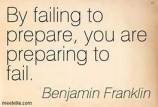
Prepare Yourself Well

franklin-quoteNote:  The following post was created as part a series of 5 posts overall to address student members of professional associations about the value of membership and engagement.

When I was an undergraduate (long ago in a galaxy far, far away), my roommate’s father came to our school to give a presentation. Prior to the event, we spent some time talking, and I asked him the basic point of what he was going to say. His words have stuck with me over the years, and this is what he said: “Prepare yourself well. There is plenty of room at the top, it is the bottom that is full.”

The adolescent, cynical side of me thought he was just making sure we didn’t waste the tuition money our parents were all coughing up. However, I knew intuitively that what he said was also true. What I didn’t grasp at the time, though, was that “preparing yourself” never ends. Looking at the rapid arc of change that is occurring in just about every sector of society, whether business or science—I’ve come to realize that preparation is not something you do once. It is something you do every day. Every day I have to get ready to do my very best work. The times demand it, and to contribute anywhere with excellence, I must model that kind of commitment to preparation. It’s a process, not an accomplishment.

How are you preparing yourself? What is your plan? And if you articulated where you are aiming, is it at the place where there is plenty of room (the top) or where it is crowded (the bottom)? Thinking about this over the holidays I was reminded of the commercial where the kid says, “When I grow up I want to claw my way all the way up to middle management.” Doesn’t being a professional imply we want more than that? And where do you go for context and opportunity to continue preparing yourself?


1 Comment

Filed under Associations, Leadership, Personal Growth and Development, Recruitment and Retention, Sustaining Excellence

Executives and the Four Directions

UnknownNative Americans have the concept of a medicine wheel, based on four directions:  North, East, South, and West.  While I am simplifying the concept, they believe that health is achieved through balance in these four directions.

Association and nonprofit executives have four directions they can face as well.  For association executives, you can be member facing, staff facing, advocacy facing, or industry facing.  When you look at how associations hire, you can tell what they want in an exec in terms of what constitutes an optimal balance for their organization.  If an association is looking for a former congressperson, for example, there is a strong indication that their “balance” will be weighted more toward the advocacy facing individual.  If they hire within their profession or interest group, it may well indicate that a member facing executive is important to them.

Nonprofit executives have a similar set of “directions” they can face as well.  A nonprofit executive can be staff facing, beneficiary facing, donor/funder facing, or community facing.  Depending on the nature and needs of the nonprofit, any of these directions can be primary at a given point in time.

A key for executive success is understanding the organization’s needs and context, the Board’s expectations, and the executive’s skill set and interest, and how these three dynamics define a healthy balance in the four directions.  It is also important to know that the needs of an organization can change—either over time, or quickly, depending on context and events.

As executives, knowing both our natural comfort, skill, knowledge, and ability regarding each of these directions is imperative.  Examining ourselves, and seeking professional development opportunities to help round out and balance our knowledge is critical.  It is also important to review these “directions” with the Board, to make sure that how the executive is orienting her/himself is consistent with the Board’s understanding of the needs and priorities of the organization.

One good tool that provides assessment of career cycle, strengths, skills, and balance is The Association CEO Handbook, by Paul Belford.  In disclosure, while I wrote the foreword to the book I have no financial interest in it.  The content can help improve an individual’s awareness of strengths and development needs.  Whatever tools you use, though, make an assessment—in what direction has the majority of your time actually been spent in the last year?  Is that the most critical to the needs and priorities of the organization, or the most comfortable because it is your wheelhouse?  What needs to be re-calibrated for you to have optimal balance?


Michael Bowers provides consultation to organizations addressing strategic, programmatic, and operational challenges and coaching to association and nonprofit executives.

Leave a comment

Filed under Associations, Executive Directors, Leadership, Personal Growth and Development, Sustaining Excellence

Sustaining the Capacity for Leadership


adams-quote-2

During a question and answer period at a recent professional meeting, I was asked how I sustained the capacity for leadership over time. It was a great question—one that I had thought about previously and a lot more since that event.

First, for me, leadership is behavior, not position. We’ve all known or seen individuals who have positions of leadership that we wouldn’t choose to follow. And we’ve also seen others, who didn’t have official positions of leadership who, nevertheless, commanded respect of others who would follow them almost anywhere. Some characteristics that have been well written about that determine leadership include such things as commitment to clear principles and values, the ability to articulate a compelling “why” for the direction that is chosen, and an ability to help others identify and maximize their unique contributions to the cause and direction of the leader. But the question still remains: in a world of so much noise and distraction, and with competing priorities all of which may have validity and meaning, how does someone maintain focus and consistency over time? What disciplines provide the best soil for leadership to grow?

I strive to be consistent in four disciplines (albeit imperfectly) that center my life and prepare me for service, whether as a leader or a follower. They are:

1. Spiritual Discipline. By this I do not necessarily mean a religious discipline, although certainly that can be a central component. But to be centered as a person and as a designated leader, I have found it essential to take time, preferably daily, to focus myself in a spiritual sense. The disciplines include journaling, reflection, meditation/prayer, and other activities aimed at keeping me focused on the greater part of who I am—my greater angels.
2. Mental Discipline. I try to make it a point to keep at least three non-fiction books going at any given time—usually a biography that provides some human/historical learning, a business book that gives insight/skills, and a “free choice” that may include anything from a book on guitars to the bucket list scuba dives that I want to do. One aspect of sustaining leadership is to foster intellectual curiosity, and while that may come naturally for some, I find that I can get so busy doing the tasks of the day that if I don’t name it as a specific discipline it can be one of those important things I don’t do consistently.
3. Creative Discipline. Aside from the mental discipline of trying to learn and be intellectually curious, I find it critical to also engage creatively as a conscious exercise in life. I have been a musician at some level of proficiency for many years, both as a writer and performer. The wonderful thing about undertaking a creative discipline is that one is almost required to approach creativity with a “beginner’s mind.” Whether writing, playing an instrument, painting, or any other creative endeavor, one enters creativity with a sense of wonder, and (for me, at least, some degree of feeling of incompetence!). Of course, Picasso didn’t start out as Picasso, either. But the creative process forces me to a place of learning and wonder (and sometimes frustration), that provides not only focus that is different from my daily tasks, but that also teaches me anew what it is like to be a learner. I believe this is a vital bit of knowledge and empathy for any leader.
4. Physical Discipline. Part of sustaining the capacity to serve or lead is to make sure that one has the physical stamina, capability, and health to do so. Study after study indicates that we are too sedentary, and “under-dose” ourselves with physical exertion and exercise. It’s important to work the heart and the body, and to sweat regularly! It is also important to pay attention to diet and sleep. Leaders–particularly those whose work is mostly cerebral or relational, need the endorphin kick of exercise to renew themselves, and sufficient rest to rejuvenate.

These disciplines don’t guarantee that anyone will be appointed to a position of leadership. But engaged in consciously and consistently provides the best context for a life of meaning, depth, and service, out of which the best leadership can flow.

Leave a comment

Filed under Executive Directors, Leadership, Personal Growth and Development, Success Metrics, Sustaining Excellence