

Tag Archives: association resources

Improving Board Performance Through New Board Member Orientation

imagesWhen I first became an Executive Director, for the American Association for Marriage and Family Therapy there was no formal process for orienting new members who had been elected to the Board of Directors.  That was in 1993.  Last year, in a presentation on financial orientation for new Board members sponsored by ASAE, it was stated that only 41% of associations conduct Board orientations.  In the long period between 1993 and 2012, there have been financial and other “scandals” involving prominent nonprofits, significant changes in law that impacts non-profits, and a sea change in technology that has created more demand for transparency in organizational governance.  Aside from the legal and fiduciary exposure, social media use by organizations brings governance into much clearer focus for members, stakeholders, and the public.  More than ever, Board members need to begin their terms of service with knowledge of the strategic vision and direction of the organization, as well as more knowledge of how the parts fit together.

Call it overkill, or caution, or simply the inherent interest of systems-oriented therapists in processes, but at AAMFT we created an orientation for all newly elected Board members that, in reality, begins at the nomination phase.   After individuals are elected, there is a mandatory one and a half-two day orientation period that is hosted in the Association’s headquarters.  The orientation is hosted by the President, President-Elect, and Executive Director of the Association. Of particular focus during that time:

  1. Having newly elected Board members speak to their personal aspirations for Board service, and how they would define success.  Common questions: “If you are successful in your Board service, what will the Association look like at the end of your term? What issues will have been addressed that you see as important in the next three years? What would you like to make sure is maintained, and what would you like to see changed, improved, or eliminated?
    Even though individuals address this in platform statements, etc., their views evolve and become more relevant to them after election.  This information also gives the leadership significant clues about how Board culture might evolve, and how Board dialogue might be carried forward.
  2. Reviewing the principles outlined in the American Bar Association’s book, Guidebook for Directors of Nonprofit Corporations.
  3. Reviewing the specific policies of the Association that are based on the Guidebook.  (AAMFT has a Governance Manual that includes, among other things, the Strategic Plan, the Board Calendar, the Code of Conduct, Conflict of Interest Policies, Board Member Role and Responsibility, Relationship with Staff, and more.)
  4. Reviewing the Finances and Corporate Structure.  There is a presentation (mentioned above) that offers great information on financial orientation on ASAE’s website if you are a member.
  5. Discussion of current landscape of the association.  This changes annually, but allows for some in-depth exploration (circling back to the beginning) about issues the Board is currently deliberating, the political climate internally and externally, etc.  It is in this section that there is discussion of the key questions outlined in the book, The Will to Govern Well.  These questions look at what is known about the current needs, wants, and preferences of members and stakeholders, the organization’s strategic capacity and position, the external trends that will impact the organization and the ethical implications of some of the issues before the organization.

Of all the tools, programs, training, etc., that can be provided to organizational leaders, this program of orientation has been vital in building collaboration, knowledge-based decision making by the Board, and better communications with members and the public about the governance and operations of the organization.   If your organization is one of the 59 percent that is not doing an orientation for incoming Board members, what are you waiting for?  Being a Board member is one thing.  Being a Good Board member is more challenging than ever, and even the most committed, well-meaning individuals who serve can use orientation, training, and “on-boarding” processes to help them toward success and meaningful contribution.

Leave a comment

Filed under Board Development, Executive Directors, Leadership

What is Your Natural Leadership “Position?”

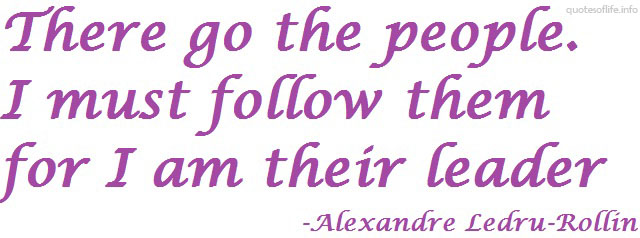
There-go-the-people-I-must-follow-them-for-I-am-their-leader-Alexandre-Ledru-Rollin-leadership-picture-quoteThere is no shortage of books, articles, and training materials on leadership.  One can learn about collaborative leadership, facilitative leadership, or in one article, 19 different styles of leadership.  While much of this can be helpful, all of it combined together can be confusing, and at times contradictory.  Is leadership innate, or learned?  Can one simply choose what kind of leader to be in any given circumstance, or do personal traits define what type of leader you will most likely be?

The answer to those questions may simply be “yes.”  In addition to learning about leadership styles, I’ve found it helpful to consider “positions” in leadership.  Considering “where you need to be” to lead effectively can help define your leadership tasks and enhance your odds of being successful in leadership.

Leading From the Front

This is the stereotypical leader—one who is charging ahead, giving direction, showing the way.  Certainly, it helps to be a visionary or to have charisma to lead from the front.  Those who can carry a crowd with a speech are sometimes referred to as “natural” leaders.  However, there are other times when leading from the front is seen as 1) distant, 2) autocratic, 3) out of touch, or 4) unrealistic.

When is leading from the front most effective?  When people are lacking a vision of success, unclear about direction or goals, or so fearful of failure that they will not risk action.

What should you do?  Focus yourself—and others to become clear on vision, direction, meaning, goal attainment, and the meaning of reaching for those goals.

Think for a moment—who are those you know, or know of, who have demonstrated clear and powerful “leadership from the front?”

Leading from the Middle

This position of leadership perhaps falls into facilitative leadership models.  However, the individual who leads from the middle isn’t focused narrowly.  Leading from the middle is more about ensuring that the resources are available (both human and financial) and more importantly that they are aligned toward the common vision of success.

When is leading from the middle not only effective but necessary?  When the organization and/or staff have a definition of success, and goals that have been established, but have not been effectively organized, aligned, or resourced to be most effective.  Another visionary speech won’t fix this issue.  The situation requires someone to lead by system building, someone who will create the processes and mechanisms for effectiveness, efficiency, and outcome.

Leading from Behind

Leading from Behind is the hidden work of leadership.  It is focused more on individuals, or small groups.  You might call it coaching, mentoring, advising, or encouraging risk by people you recognize have the skills, but perhaps not the confidence.

When to lead from behind?  When the vision is clear, and the basic systems and resources are in place, your role as a leader is in people development.  Individuals (and teams) need to know you have confidence in them to do a good job, and to succeed.  This isn’t simply cheerleading, it is creating the environment where staff—or volunteers feel comfortable stepping out, stretching, and achieving.  Think what you would have wanted from a supervisor at a challenging point in your career, and see if you can give it to those you work with, and who work for you.  If in doubt, ask them…

A quote is attributed to Dwight Eisenhower:  “Leadership is getting people to do what you want them to do and having them think it was their idea all the time.”

Recognizing not only your natural comfort position in leadership, but also what the context demands, will help you stretch your leadership skills and succeed.

Leave a comment

Filed under Executive Directors, Leadership

Hiring Well: Three “C”s to Consider

blocksIt is no secret: personnel issues are a point of pain for association and nonprofit executives.  To date, Assessing Personnel Problems: Three Questions to Ask has generated many further questions and follow up.  One major key in avoiding, or minimizing personnel issues, is hiring well.

There is no shortage of information to be found about the hiring process.  You can read about how to grade applicants, which body part to use when interviewing, and a method for determining who to hire.  It is true that many fall into less than optimal practices at the hiring point that lead to challenges later.

For mission and value based organizations, I have found three categories on which to evaluate a potential hire that maximize the potential for success.  While different words might be used, these are the dimensions on which I evaluate potential hires:

Culture

What kind of culture do you wish to create or enhance in your workplace?  Can you articulate it in clear and measurable terms?  Different workplaces can have profoundly different aspirations about culture.  Think of the difference between an NFL team and an arts organization.

I’ve learned over the years that this component is easy to overlook in the hiring process, or at least to minimize.  Sometimes it gets confused with chemistry—which is whether you like someone or not.  This is a more direct evaluation of how someone will contribute intentionally to the work atmosphere and values, not whether you could be friends with someone.  After several mistakes in this area, I’ve come to believe that if there are red flags here, it is better to leave a position vacant than to bring someone into the work environment who reflects an outlook, values, and comfort with a culture different than the one you want reflected in your workplace.

Competence

Obviously you want the person with the best skills and knowledge to perform the work defined in the position description.  That should be assessed clearly and well.  But there is another dimension here:  what is the person’s native ability to connect their work to the larger whole?  In a more connected world, competence no longer is limited to the specific tasks and outputs of a single job description.  To maximize impact, competence now includes the ability to multiply value by connecting that work to the larger whole.

Character

What is the core of this individual?  What questions do I need to ask relative to this work environment that will help me assess the character of this person?  And yes, there are many questions that are legal to ask in the hiring process that will get at this component of the hiring evaluation.  While companies rely more on background checks to assess basic information, and references become more skittish to provide an in depth statement about individuals for fear of possible litigation, this dimension is worth exploring with several questions directly aimed at assessing character.

Culture, Competence, Character.  If you assess in these dimensions, and find a fit that works for your organization, the instances of future personnel problems will be diminished.  Give thought to what you want, and don’t hire something significantly outside those parameters.

1 Comment

Filed under Executive Directors, Staff Management

Resources: You May Have More Than You Think!

thThe story is told of a sign in a Pentagon procurement office that said, “Better, Faster, Cheaper:  Pick Any Two.”  While humorous in a way, we recognize some (painful) truth in the statement.

In a parallel way, leaders in nonprofit organizations also have three types of resources (and therefore choices) at their disposal.  To maximize the impact of an organization’s programming and vision, we need to build a strategy using all three.

The three types of resources every organization has are Time, Money, and People.  Typically we think first (and sometimes only) of money as the basic resource to drive an organization’s progress. You read often that fund development is the chief priority for an organization—and that would be true for any organization these days, really. The type of algorithm in the Pentagon sign exists, no doubt.  If you have less money, you may have to find ways to maximize your “people” resource.  If you don’t have a lot of either, then time may become a resource—it may take longer to achieve your objective, but there are ways to use time to build your programming as well.

We all know about financial budgeting and management, but I’ve also seen organizations create very successful advocacy campaigns using people power.  Organizations can succeed primarily using the intellectual capital and of their volunteers or their profession.  However, I’ve seen many fewer organizations that actually consider creating a human capital budget, or that even know how many hours or to what end they have volunteers contributing over any given cycle.

Have you done a “human capital” (people) assessment of your organization?  Do you know how you are spending volunteers’ energy and commitment, and how that relates to your strategic priorities?  Do you have a human capital development plan that will help build the strategic capacity of your organization?  This resource can be as vital, and sometimes more vital, than having funds to spend on certain initiatives.

Time is also an asset.  Occasionally, we don’t have much of it, or we use it to create and drive an agenda.  The National Breast Cancer Coalition, for example, has identified the year 2020 as the deadline to end breast cancer.  It is using time as an asset, to create urgency for people and funding.

Some things are calendar driven, and must be considered in light of deadlines.  Then again, there is a saying that “Time cures.”  Do you ask, when considering an issue, whether it requires money, people, or time?  Time can be used another way: in sequencing well.  For some issues, if you do the right things first (using time correctly) you may not have to do several other things—they may take care of themselves.

Take the opportunity to do a global assessment of your organization’s strategic capacity in these three areas.  How does your organization consider, count, and use its’ people, its’ time, and then, its’ money.  By being conscious in this assessment, you may well find resources you didn’t know you had, or be able to capitalize and deploy the resources you have in a more effective way.

1 Comment

Filed under Board Development, Executive Directors, Resource Development, Success Metrics

Assessing Personnel “Problems:” Three Questions to Ask

imagesNothing drains more energy or time from an association/nonprofit executive than when there are indications of a problem with staff.  It may be phone calls about poor customer service from members or leaders, missed deadlines or failure to respond appropriately, or any other number of signs that something is amiss.

Many times I hear execs say that they waited too long to intervene.  Other times I hear from staff that there is a sudden confrontation with no ability to explore the problem in a collaborative manner.   How can executives proceed in a fashion that will address the problem directly yet leave the most opportunity and ground for growth and ultimate success in dealing with a problematic staff issue?

I’ve found a three step process allows for an exploration, understanding, and creating a sound strategy for moving forward in these circumstances.   At times, there may not be a personnel issue at all.  Here are the questions to ask—and the order in which to move through the assessment:

Is there a systemic/process breakdown that is creating or exacerbating the problem?

There are times when what appears to be a problematic staff performance issue isn’t that at all.  There is, rather a systemic problem that is leading to breakdowns in staff capability to perform.  If the systemic problems are addressed, the performance problem may disappear.  Systemic problems may be problems of coordination/communication between people, processes, or departments, hardware or software malfunction, or any other number of structure/process/program issues.  If someone hasn’t been responsive, it is not productive to confront them only to discover that because of some communication breakdown they never received instructions, directions, etc.  Unfortunately, in human designed systems, whether management systems or computer, etc., there are sometimes built in glitches that create problems.  Before presuming you have a staff performance issue, make sure that there are not impediments that have been “cooked in” to the system.  That’s your first job as a manager in assessing performance and creating a context for excellence.

Is there a resource problem that is preventing the performance that is expected?

If you are sure that the management and communications systems are working properly and are coordinated well, the next level of question is whether or not there is a resource issue that is keeping the staff person from performing appropriately.  Do they have the equipment they need to perform well?  Do they have the training to function with excellence?  Do they have the information/direction needed to complete the task in line with expectations?  Do they have the time to do the work?  Is there so much work assigned that it is unreasonable to expect a well trained, appropriately oriented and equipped staff person to perform the work well.  Until these two basic questions can be answered in the affirmative, there is no way to tell whether you have a true staff performance problem, or a system/resource problem.

After answering the first two questions, then there is the third: Is this problem chronic or random?

Humans are human.  Even superstars make mistakes, and sometimes they make fairly big ones.  But these mistakes are outliers, and not the norm for a good staffer who is trained, equipped, and placed in a working system.

On the other hand, there are people who are either not suited for certain work, not compatible with an organizational culture, or not interested in performing to the standards of the organization (although I believe this is rare if the first two conditions are addressed appropriately).  In such instances, after having completed the assessments in the questions above, it is time for legitimate intervention.

The Bottom Line

Most people want to do well in their work.  For associations and nonprofits, it is much better to tap into that desire to do well, and to ensure that staff are embedded in a functional management system, with appropriate resources, direction, etc., and a clear sense of expectation.  You’ll save yourself a lot of grief, grow your staff toward excellence, and potentially even avoid employment related litigation (a large and growing concern in our sector) if you can demonstrate that you’ve done everything you need to do in terms of providing systems, training, and opportunity for staff to succeed.

2 Comments

Filed under Executive Directors, Staff Management

How to Move Boards from Operations to Strategy

A3d_pie_chart common theme that has been addressed in several forums lately (nonprofit vs. for profit challenges/styles, Boards that micro-manage, etc.) is how to get Boards to move out of operations and into strategic issues and discussions.  While there is no “one time” solution, or “one size fits all” intervention, there are some very practical ways to help Board members understand the horizon they should be considering in their role.

For individual member associations, and even for many trades, Board members arrive at their positions having climbed the leadership ladder in the organization.  Many times, that means moving from components with lower budgets, fewer (or in some cases no) staff, and where the volunteer base is also the workforce.  We are all probably familiar with the terms “working Board” in that respect.  In the past, we’d refer to that as the fact that the Board and other volunteers not only do the governing, they also do the “lickin’ and stickin’.”  (No one does much lickin’ and stickin’ anymore.)  Sometimes the role is not clear, the practice is not consistent, even in an organization that has a larger staff and budget.  Staff can’t be critical of Board members if they aren’t clear and consistent in their actions as well, and ask Board members to do operational things without a clear understanding of the implications.

A tool I have used successfully to highlight this issue in Board member orientation that helps incoming (and reinforces for continuing) Board members see a bigger role for themselves is this:

1.      I make a list of different levels of staff:  a) receptionist/call center, b) “line” workers (project coordinators/administrators), c) department managers, d) executive staff, and e) the executive director.

2.      I ask the Board members to create two columns and write down in one the level of detail the positions require (at times I ask for a percentage of detail work vs the level of strategy).  In the second column I ask them to write down the length of “lead time” each level of worker needs to be thinking ahead to be successful at their jobs.

It becomes clear pretty quickly that the focus of time and attention is quite different for different levels of staff.  The specific focus of time grows shorter the closer to the front line of work one gets, and the level of detail more extensive.  You move from thinking about the work I’m doing right now (the call I have to manage, how many are in the queue) to what is next year’s budget going to be (or the year after that) and what kind of programming needs to be planned in the next three to five years.

Sometimes we then do the same thing with governance; with Components, Standing Committees, Task Forces, etc., and then the Board.  What is the focus in time that each should have, from now, to a year from now, to five or ten?  What is the level of operational detail each level of governance should have as a matter of concern?

Having Board members recognize that their job is to move farther out in time, and higher in strategy to trends and mega-issues allows them to grasp their role in strategic direction and decision in a very practical way. It becomes pretty clear that not only is there a great opportunity cost if you have Board members acting like receptionists or even project managers, but also if the Board is engaged in those areas of focus primarily, either no one—or possibly the “wrong” persons, are going to end up focusing on what should be the Board’s primary task.  I’ve seen more than one Executive Director get in trouble for “doing the Board’s work” when, in fact, the Board had neither defined its role appropriately nor equipped itself to do its job.  And if the Board isn’t doing its work at the strategic level, isn’t it better that someone is trying to do it than no one?

There is no one correct answer to the questions, or right way to fill out the charts, obviously.  And the percentage focus in time and operations/strategy can change depending on circumstances.  But this exercise gives Board members and staff a way to have direct discussions about the issue without saying someone is “right or wrong” in their view.  It gives a chance to clarify expectations, goals, etc., overtly and directly, rather than having things simmer with the real issue of scope of role never being discussed.

Yes, there’s more to it that could be written.  But this is a starting point that can be used—a tool in the toolkit for execs to help move their Boards from operations to strategy, or at least to be clear about who is doing what, and expectations of each.

Leave a comment

Filed under Board Development, Executive Directors

Two Reasons Associations Are Not, and Should Never Be, Like For Profit Corporations

     MR900432538

      We are told almost continuously that associations and nonprofits must be more like businesses to thrive, and perhaps even to survive. Associations Now ran an article just yesterday talking about how difficult it is to get nonprofits to be more like for profits.   Early on in that article, there was a link to a Google search that showed how prevalent this theme is.  I believe there are two compelling and inherent ways that associations and nonprofits are not, and should never be, like their for profit counterparts.

Associations and Nonprofits Keep Score Differently than For Profit Counterparts

For Profit Corporations exist to create wealth, whether for owners, partners, or shareholders.  By definition, that is why they exist.  If they don’t do that, they don’t stay in business very long.  While associations and nonprofits should strive to use best practice business methods, metrics, and management, and always aim for a healthy balance sheet, they are mission and values based organizations.

No one (not stockholders, owners, partners, donors, or even members) owns associations or nonprofits.  They are “owned” by their mission, and by the values embedded that define the means and methods they will use to achieve that mission.  There is something about the DNA of associations and nonprofits that makes them “look like” for profit counterparts, but genetically, they are different because of this fact.  To forget that, or worse, simply ignore it, in the interest of being “businesslike” is to abandon a unique and specific identity and purpose.

 Associations and Nonprofits Have Volunteer Human Capital as a Major Asset

The article in Associations Now referenced above basically bemoans the fact that Boards get in the way of nonprofits being more businesslike, extending the decision cycle, etc., and perhaps making things a bit messier while doing it.  I’m all for Boards being well equipped, oriented, understanding their role, and allowing qualified staff to do their jobs, etc., but again, there is something in the DNA of associations and nonprofits that is different than for profits.

For profits simply do not have volunteers, who are consistently willing to give their time, energy, and money, on behalf of the purpose of the organization, with no expectation of direct monetary/wealth return.  For associations and nonprofits, volunteer time, energy, commitment, and funds are again, in the DNA.  Something unique happens in organizations when volunteers participate.

Those who are willing to give time, energy, and money to a cause, to make something different, to be change agents, end up being changed themselves.  The changers also become the changed.  That is about identity, purpose, values, commitments, etc., that make the world more human, and I haven’t yet bought into the notion that corporations are human, my friend.  I’ve never yet met a corporation that I wanted as a true friend and intimate.  To reduce volunteerism to a point that it becomes little more than a FaceBook “like” is to cheapen what it means to support and give yourself to something greater than you are.

Say what you will about associations and nonprofits being efficient, effective, and using all appropriate business tools to be the best they can be in service to their mission, and in having the resources to do it, and knowing when they have achieved success.  Associations and nonprofits should do all of those things.  But let’s not change their DNA.  We lose way too much.

Leave a comment

Filed under Executive Directors, General, Success Metrics

The Other Kind of Identity Theft

In 2007, the CEO of LifeLock was advertising a lot about identity theft and fraud.  He was so certain of his new service that he publicized his own social security number and essentially dared anyone to try to steal his identity.  To borrow from
Dr. Phil, “How’s that working for you?”  Well, according to Digital Trends, his identity was stolen at least 13 times!  And that was in 2010!

However, there is another kind of identity theft.  It is becoming more and more true that “who you are” is who you are on the web.   While almost all  Executive Directors are paying attention to how their organizations are “branded” (another word for identity, really) in the virtual world, many fewer are paying attention or taking the time to create their own personal identity on the web.  Too often, they equate the identity of the organization with their own personal identity.  That simply isn’t true, and if Execs don’t take the time and attention to attend to their own personal identity on the web, it is only a matter of time until someone else will begin to create their identity for them.  That will seldom be done in a manner that is complimentary or positive for the executive director or staff member being so identified.  There is no such thing as “ignoring it and hoping it will disappear” on the web.

This fact is even more problematic because the social culture of the internet is to be much more direct and harsh in making derogatory statements about individuals than in personal conversation.  Add that many of these statements can be made anonymously, and can be asserted without regard to verification or even truthfulness, and there is a recipe for a very different kind of identity theft.  Before you are aware of it, the person you have worked hard to be, and who you appear to be in the virtual world can be quite different.

In addition to ensuring appropriate “branding” for organizations, Executive Directors must also take the time to attend to their personal identity (branding) on the web.  No one else will, and no one else is responsible for it.  This YouTube session from Social Media by Numbers shows the implications for organizations, and is directly applicable to individuals as well.  Your story, and your identity matter.  What is yours?  Have you–as an individual separately from your organization–decided to manage your own identity on the web?  How are you doing that?

Leave a comment

Filed under Executive Directors, Identity and Branding

Five Ted Talks Every CEO Should Watch…

The Executive Director’s Toolkit is built to provide both professional and personal resources that will assist Execs in building a life and a career that is fulfilling.  It is Friday, time to take stock and pause to consider how to recharge for next week.  From CEO.com, here are  five Ted Talks every CEO should watch.

Leave a comment

Filed under Executive Directors

Three Questions Executive Directors Want Answered about Social Media

IMG_0058

There is no hotter topic than association and nonprofit use (and metrics) of social media.  The data of the latest benchmark report on nonprofits and social media takes a while to digest, and even longer to determine relevance for any particular organization.  A benchmark does not provide any particular guide to strategy, especially if almost every organization is still struggling with issues of ROI and meaningful metrics.

I admit, as an Executive Director of 20 years experience I had questions about my association’s investment in social media.  In talking with my peers, (most of whom are also boomers), I found that my questions weren’t only mine.  One colleague said, “So, we get 10,000 likes on our Facebook page.  What does that mean?  And in the long run, how does that benefit our organization?”

Boiling down the conversations I have had with colleagues over the past couple of years, the questions come down to these:

1)       How does our investment in social media lead to an increase in conversion or retention?  Can we show that our investment in social media increases membership or product sales, or retains members?   There can be a lot of discussion about engagement, but I’m sorry to report this fact: many Executive Directors may feel that engagement on social media only is a kind of discounted engagement.  It is easy to click “like” or to follow a link, but if that doesn’t lead to measurable benefit for the organization in terms of revenue, there may be continued skepticism about the level of investment made by staff.

2)     How does our investment in social media enhance our organization’s reputation as the preeminent source of information/expertise among our communities of interest?  There may be many communities of interest…but of particular importance for many organizations (especially if the #1 question is difficult to answer), is whether others begin (or increase) their use of information provided by the organization.  For example,  as the association of which I was Executive Director, The American Association for Marriage and Family Therapy, increased its presence in social media, we directly increased calls from reporters for “mainstream” media outlets (the New York Times, Wall Street Journal, etc.).  These reporters want further information on material AAMFT had published or stories they were writing, or to use as sources for new articles.  In addition to online links, pingbacks, etc., this created an external measure of impact for our social media activities.  Social media led to earned media exposure for the organization itself.

3)     How does our investment in social media translate into use and assimilation of the organization’s (or members’) positions, advocacy or public education initiatives, or member’s business/social interests?  The key word here is translation.  Can you measure third party use or adoption of positions, statements, or key strategic messages from investment in social media.  This doesn’t mean that an organization has to produce something that goes viral, although that certainly could be one metric.  The Oregon Dental Association created the public service announcement BRUSHY, that scored several hundred thousand hits in a number of days.  By that measure it was a great success!  Now, is there a way to tell how many kids watched it, as opposed to dentists?  And is it used by pediatric dental offices for patients?  As an Executive Director, that is one question I want an answer to:  does the work translate out of the virtual world?

A social media strategy can be built that will aim at any of these three questions.  Metrics can be established that are organization/campaign specific that will help define the value and success of efforts in social media.  For many executive directors, who have to manage multiple priorities, budgets, and politics, the more practical the metrics, the more relevance of social media investments.

I’d love to hear comments or reactions to these questions and ideas.

Leave a comment

Filed under Executive Directors, Social Media, Success Metrics