
Tag Archives: CEO

Executives and the Four Directions

UnknownNative Americans have the concept of a medicine wheel, based on four directions:  North, East, South, and West.  While I am simplifying the concept, they believe that health is achieved through balance in these four directions.

Association and nonprofit executives have four directions they can face as well.  For association executives, you can be member facing, staff facing, advocacy facing, or industry facing.  When you look at how associations hire, you can tell what they want in an exec in terms of what constitutes an optimal balance for their organization.  If an association is looking for a former congressperson, for example, there is a strong indication that their “balance” will be weighted more toward the advocacy facing individual.  If they hire within their profession or interest group, it may well indicate that a member facing executive is important to them.

Nonprofit executives have a similar set of “directions” they can face as well.  A nonprofit executive can be staff facing, beneficiary facing, donor/funder facing, or community facing.  Depending on the nature and needs of the nonprofit, any of these directions can be primary at a given point in time.

A key for executive success is understanding the organization’s needs and context, the Board’s expectations, and the executive’s skill set and interest, and how these three dynamics define a healthy balance in the four directions.  It is also important to know that the needs of an organization can change—either over time, or quickly, depending on context and events.

As executives, knowing both our natural comfort, skill, knowledge, and ability regarding each of these directions is imperative.  Examining ourselves, and seeking professional development opportunities to help round out and balance our knowledge is critical.  It is also important to review these “directions” with the Board, to make sure that how the executive is orienting her/himself is consistent with the Board’s understanding of the needs and priorities of the organization.

One good tool that provides assessment of career cycle, strengths, skills, and balance is The Association CEO Handbook, by Paul Belford.  In disclosure, while I wrote the foreword to the book I have no financial interest in it.  The content can help improve an individual’s awareness of strengths and development needs.  Whatever tools you use, though, make an assessment—in what direction has the majority of your time actually been spent in the last year?  Is that the most critical to the needs and priorities of the organization, or the most comfortable because it is your wheelhouse?  What needs to be re-calibrated for you to have optimal balance?


Michael Bowers provides consultation to organizations addressing strategic, programmatic, and operational challenges and coaching to association and nonprofit executives.

Leave a comment

Filed under Associations, Executive Directors, Leadership, Personal Growth and Development, Sustaining Excellence

Checkup: 4 Key Accountabilities an Executive has to Her/His Team

Unknown

There are baseline responsibilities all leaders have to their teams. Do an assessment—or better yet, ask your team.  How are you doing with these key accountabilities?

  • Establish a clear, commonly understood, and attainable definition of success.

To be engaged, teams have to know where they are headed, what success looks like, and they must believe they can achieve it.  Can your staff clearly and easily articulate what success is for them?  For your organization overall?

  • Create and maintain structures and processes that facilitate moving toward success.

Too many times, our systems, structures, and processes are not aligned with the goals we have established for success.  How do you monitor and adjust your management systems and processes so they help align and engage your team toward that clear definition of success you have established?  Perhaps more importantly—does your staff team believe that you focus on aligning systems and processes to help facilitate their success?  How do you know?

  • Provide opportunities for development and growth for your team.

To build and maintain excellence, you must offer your staff opportunities to learn and grow.  This can build your bench strength and cross train your staff.  For many smaller associations and nonprofits without a significant career growth ladder, you may be training folks to leave for more advanced work in some instances.  However, the price of not investing in growth and development is a non-engaged workforce and entropy.  What formal and informal mechanisms do you have—that your staff can identify—that gives them a sense that you care about their growth and careers?

  • Create and Maintain a culture of trust and safety.

A search of contents on Harvard Business Review shows 213 offerings on “employee trust.” Add articles on “leadership,” and “employee engagement,” or just “trust”, and the numbers go up exponentially.  The fact is, if your team doesn’t have confidence in you and a sense of trust and safety, it may not matter if you have met the other accountabilities listed above.  In fact, it may not be possible to successfully achieve the three prior accountabilities if there is not a bedrock of trust.  Again, it is your team that can best answer whether trust and safety is present in the workplace, not you as the leader.  How long has it been since you’ve asked?

Put these accountabilities to the test!  Create and consistently implement a plan to consistently ensure that you are meeting them.  These are keys to success.

Leave a comment

Filed under Associations, Executive Directors, Leadership, Staff Management, Sustaining Excellence

Sustaining the Capacity for Leadership


adams-quote-2

During a question and answer period at a recent professional meeting, I was asked how I sustained the capacity for leadership over time. It was a great question—one that I had thought about previously and a lot more since that event.

First, for me, leadership is behavior, not position. We’ve all known or seen individuals who have positions of leadership that we wouldn’t choose to follow. And we’ve also seen others, who didn’t have official positions of leadership who, nevertheless, commanded respect of others who would follow them almost anywhere. Some characteristics that have been well written about that determine leadership include such things as commitment to clear principles and values, the ability to articulate a compelling “why” for the direction that is chosen, and an ability to help others identify and maximize their unique contributions to the cause and direction of the leader. But the question still remains: in a world of so much noise and distraction, and with competing priorities all of which may have validity and meaning, how does someone maintain focus and consistency over time? What disciplines provide the best soil for leadership to grow?

I strive to be consistent in four disciplines (albeit imperfectly) that center my life and prepare me for service, whether as a leader or a follower. They are:

1. Spiritual Discipline. By this I do not necessarily mean a religious discipline, although certainly that can be a central component. But to be centered as a person and as a designated leader, I have found it essential to take time, preferably daily, to focus myself in a spiritual sense. The disciplines include journaling, reflection, meditation/prayer, and other activities aimed at keeping me focused on the greater part of who I am—my greater angels.
2. Mental Discipline. I try to make it a point to keep at least three non-fiction books going at any given time—usually a biography that provides some human/historical learning, a business book that gives insight/skills, and a “free choice” that may include anything from a book on guitars to the bucket list scuba dives that I want to do. One aspect of sustaining leadership is to foster intellectual curiosity, and while that may come naturally for some, I find that I can get so busy doing the tasks of the day that if I don’t name it as a specific discipline it can be one of those important things I don’t do consistently.
3. Creative Discipline. Aside from the mental discipline of trying to learn and be intellectually curious, I find it critical to also engage creatively as a conscious exercise in life. I have been a musician at some level of proficiency for many years, both as a writer and performer. The wonderful thing about undertaking a creative discipline is that one is almost required to approach creativity with a “beginner’s mind.” Whether writing, playing an instrument, painting, or any other creative endeavor, one enters creativity with a sense of wonder, and (for me, at least, some degree of feeling of incompetence!). Of course, Picasso didn’t start out as Picasso, either. But the creative process forces me to a place of learning and wonder (and sometimes frustration), that provides not only focus that is different from my daily tasks, but that also teaches me anew what it is like to be a learner. I believe this is a vital bit of knowledge and empathy for any leader.
4. Physical Discipline. Part of sustaining the capacity to serve or lead is to make sure that one has the physical stamina, capability, and health to do so. Study after study indicates that we are too sedentary, and “under-dose” ourselves with physical exertion and exercise. It’s important to work the heart and the body, and to sweat regularly! It is also important to pay attention to diet and sleep. Leaders–particularly those whose work is mostly cerebral or relational, need the endorphin kick of exercise to renew themselves, and sufficient rest to rejuvenate.

These disciplines don’t guarantee that anyone will be appointed to a position of leadership. But engaged in consciously and consistently provides the best context for a life of meaning, depth, and service, out of which the best leadership can flow.

Leave a comment

Filed under Executive Directors, Leadership, Personal Growth and Development, Success Metrics, Sustaining Excellence

Three Dimensions For Building and Sustaining a Meaningful Culture

UnknownOne question that I am asked—and ask myself routinely—is how to build and sustain a meaningful culture in an organization. While leaders may aspire to somewhat different traits in a culture (trust, productivity, engagement, a service orientation, etc.), all who are serious about the quest look for resources, tools, etc., to be successful.

There is good news and bad news in this search. The good news is that it is possible to build and sustain a positive culture that embodies the traits a leader seeks, through hiring well, building systems and processes, and defining a vision that connects what people do with why they do it.  The recent book by Simon Sinek, Start with Why, gives a basis for the “why” as a foundation to get to the “how.”

The “bad news” is that any leader who believes s/he can build and sustain a meaningful culture with a set of tools, processes, techniques, or even compelling vision, without embodying the aspired culture is mistaken.  Such a leader may have a shell of a culture, but without the leader infusing the desired traits and qualities into her/his own life, it will never become part of the DNA of the leader’s organization.

The bottom line is that like an artist regardless of medium (paint, performance, music), the primary instrument any leader has to define and instill a culture is the person of the leader him/herself. There is no way to avoid that reality, and leaders who try to avoid it never achieve the culture building success to which they aspire.   Given that fact, here are three critical aspects a leader must continually cultivate:

  1. Clarity of intention.  Leaders are pulled in many directions, and sometimes values clash in desired outcomes or culture.  The leader’s first task in building and sustaining culture is to be very clear about the qualities one is trying to build and sustain, and to examine every initiative, action, etc., in light of those qualities.  When qualities or dimensions of culture seem to conflict, the leader must determine which dimensions are bedrock, and build actions that reflect, in relative importance, the dimensions of culture that matter most.
  2. Personal character that is congruent with the desired culture. Put simply, leaders “get back” what they “are.”  If you want a culture of trust, reflect trust in your team.  If you want a culture of engagement—engage!  And so on.  The key for this aspect is to be unsparing (although kind) of yourself in continually examining how you can better reflect the culture you are trying to build and sustain. Creating 360 mechanisms to discover if what you are intending to communicate is what is being received is critical.
  3. Consistency of application over time.  If a culture is to be changed, built, and sustained, above all else, the leader must be committed to the aspects of culture consistently—actually, constantly—over time.  It is perhaps here that most culture change efforts fail.  People get busy, other priorities intervene (culture can seem nebulous in the midst of a crunch of quantifiable measures and deadlines), and culture grows like a garden untended.  No matter how well manicured it may have been at one time, without attention, weeds and pests arise. Leaders must commit to culture building and sustaining as a focused process that is “someone’s job to worry about at night.”  And yes, that job ultimately belongs to the leader, as the primary culture builder and culture bearer. 

If you want to change, build, or sustain a culture in an organization, not only must you start with the why—you must start with yourself.  Find honest mentors/advisors, and begin the quest.  Everyone in the organization will benefit—and you as a leader will the most.

Leave a comment

Filed under Executive Directors, Leadership

Expanding Your Leadership Presence: Managing Meaning

imagesIt is not uncommon when coaching newly-minted or aspiring CEOs in associations to hear them express the desire to expand their leadership presence.  While being promoted from within vs. coming onboard from outside an organization pose different challenges, establishing and expanding leadership presence early is critical.

One trap newly hatched CEOs can easily fall into is believing that they were hired because of what they were doing well previously.  They assume they need to do more of that same thing, perhaps better and with more diligence to have success.  Unfortunately, in many cases this is not true.  While the skill set and persona that created the opportunity to lead is vital, the reality is that moving to a new level of responsibility—at the enterprise level—requires different skills and perspective than those that brought success previously.

One CEO I worked with was having a difficult time making the transition, and couldn’t really grasp the concept of stepping beyond his previously successful management focus and perspective.  Outside work, he was a car buff, and after some unfruitful discussion, I drew the following analogy that made sense for him and helped him shift.  It went like this:

Previously you were successful because you knew how to do things.  Now, your role is to define and manage why you do things.  Look at cars as an example:

There are some who have expertise and complete competence in transmissions.  They can take them apart and rebuild them in their sleep.

As they gain more experience and perspective, they may become experts in the drive train, looking not only at the transmission, but the system and interaction between transmission and motor/propulsion system.  The learn torque, power, etc., and how to maximize what is needed.  Others may focus on safety features, electrical systems, etc. as well.

Moving beyond the various systems is the designer, who has to make sure the systems all work together and that the sum is maximized to achieve the primary intent of the designer. 

Beyond the designer is the company/enterprise level.  What kind of vehicle are we building?  Is it intended for speed, durability, safety, style, transport of passengers/cargo, economy, luxury, etc?  Are we building for the racetrack or the Australian outback?  What is the market for this type of vehicle?  How does it fit into the company image, brand, etc.?  How does it fit into the market as it exists or is envisioned?  What will building this vehicle, at this time, do to position the company/enterprise as a whole, and where does it imply we are headed?  Is that where we want to go? 

This analogy gave this new CEO a way to understand the shift he needed to make.  In a real way, he needed to “step up” in his focus and vision.  It didn’t matter how good he had previously been in his more specific role, the goal now was much more to know WHY the organization was doing what it was doing (overall), rather than the how of an individual system or component.  Then, his job was to ALIGN the different components toward that WHY and definition of success, and to manage the culture and processes so that they were in sync with that WHY. Too much attention on one system or component of the organization, and he would fail—no matter how good that one system worked.  While a car must have a working transmission to move, it is much more than just the transmission.

When a CEO can help create and manage meaning, s/he has taken a very critical and primary step toward expanding leadership presence and long-term success.  How much energy and time do you devote to making sure the why of everything you do is aligned, and that it is commonly understood?  What mechanisms and processes do you use to ensure that you are managing meaning throughout your organization?

Here are two resources, both published this year, that may assist new CEOs in their development:

The Association CEO Handbook is filled with assessment questions, a particular beginning place for this kind of analysis is found on pp. 59-64.  (Disclosure:  I wrote the foreword for this book but have no financial interest.)

The First 90 Days (updated and expanded):  Proven Strategies for Getting Up to Speed Faster and Smarter, Harvard University Press.

Leave a comment

Filed under Executive Directors, Leadership

What is Your Natural Leadership “Position?”

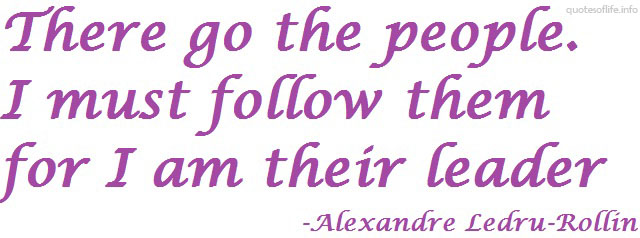
There-go-the-people-I-must-follow-them-for-I-am-their-leader-Alexandre-Ledru-Rollin-leadership-picture-quoteThere is no shortage of books, articles, and training materials on leadership.  One can learn about collaborative leadership, facilitative leadership, or in one article, 19 different styles of leadership.  While much of this can be helpful, all of it combined together can be confusing, and at times contradictory.  Is leadership innate, or learned?  Can one simply choose what kind of leader to be in any given circumstance, or do personal traits define what type of leader you will most likely be?

The answer to those questions may simply be “yes.”  In addition to learning about leadership styles, I’ve found it helpful to consider “positions” in leadership.  Considering “where you need to be” to lead effectively can help define your leadership tasks and enhance your odds of being successful in leadership.

Leading From the Front

This is the stereotypical leader—one who is charging ahead, giving direction, showing the way.  Certainly, it helps to be a visionary or to have charisma to lead from the front.  Those who can carry a crowd with a speech are sometimes referred to as “natural” leaders.  However, there are other times when leading from the front is seen as 1) distant, 2) autocratic, 3) out of touch, or 4) unrealistic.

When is leading from the front most effective?  When people are lacking a vision of success, unclear about direction or goals, or so fearful of failure that they will not risk action.

What should you do?  Focus yourself—and others to become clear on vision, direction, meaning, goal attainment, and the meaning of reaching for those goals.

Think for a moment—who are those you know, or know of, who have demonstrated clear and powerful “leadership from the front?”

Leading from the Middle

This position of leadership perhaps falls into facilitative leadership models.  However, the individual who leads from the middle isn’t focused narrowly.  Leading from the middle is more about ensuring that the resources are available (both human and financial) and more importantly that they are aligned toward the common vision of success.

When is leading from the middle not only effective but necessary?  When the organization and/or staff have a definition of success, and goals that have been established, but have not been effectively organized, aligned, or resourced to be most effective.  Another visionary speech won’t fix this issue.  The situation requires someone to lead by system building, someone who will create the processes and mechanisms for effectiveness, efficiency, and outcome.

Leading from Behind

Leading from Behind is the hidden work of leadership.  It is focused more on individuals, or small groups.  You might call it coaching, mentoring, advising, or encouraging risk by people you recognize have the skills, but perhaps not the confidence.

When to lead from behind?  When the vision is clear, and the basic systems and resources are in place, your role as a leader is in people development.  Individuals (and teams) need to know you have confidence in them to do a good job, and to succeed.  This isn’t simply cheerleading, it is creating the environment where staff—or volunteers feel comfortable stepping out, stretching, and achieving.  Think what you would have wanted from a supervisor at a challenging point in your career, and see if you can give it to those you work with, and who work for you.  If in doubt, ask them…

A quote is attributed to Dwight Eisenhower:  “Leadership is getting people to do what you want them to do and having them think it was their idea all the time.”

Recognizing not only your natural comfort position in leadership, but also what the context demands, will help you stretch your leadership skills and succeed.

Leave a comment

Filed under Executive Directors, Leadership

Hiring Well: Three “C”s to Consider

blocksIt is no secret: personnel issues are a point of pain for association and nonprofit executives.  To date, Assessing Personnel Problems: Three Questions to Ask has generated many further questions and follow up.  One major key in avoiding, or minimizing personnel issues, is hiring well.

There is no shortage of information to be found about the hiring process.  You can read about how to grade applicants, which body part to use when interviewing, and a method for determining who to hire.  It is true that many fall into less than optimal practices at the hiring point that lead to challenges later.

For mission and value based organizations, I have found three categories on which to evaluate a potential hire that maximize the potential for success.  While different words might be used, these are the dimensions on which I evaluate potential hires:

Culture

What kind of culture do you wish to create or enhance in your workplace?  Can you articulate it in clear and measurable terms?  Different workplaces can have profoundly different aspirations about culture.  Think of the difference between an NFL team and an arts organization.

I’ve learned over the years that this component is easy to overlook in the hiring process, or at least to minimize.  Sometimes it gets confused with chemistry—which is whether you like someone or not.  This is a more direct evaluation of how someone will contribute intentionally to the work atmosphere and values, not whether you could be friends with someone.  After several mistakes in this area, I’ve come to believe that if there are red flags here, it is better to leave a position vacant than to bring someone into the work environment who reflects an outlook, values, and comfort with a culture different than the one you want reflected in your workplace.

Competence

Obviously you want the person with the best skills and knowledge to perform the work defined in the position description.  That should be assessed clearly and well.  But there is another dimension here:  what is the person’s native ability to connect their work to the larger whole?  In a more connected world, competence no longer is limited to the specific tasks and outputs of a single job description.  To maximize impact, competence now includes the ability to multiply value by connecting that work to the larger whole.

Character

What is the core of this individual?  What questions do I need to ask relative to this work environment that will help me assess the character of this person?  And yes, there are many questions that are legal to ask in the hiring process that will get at this component of the hiring evaluation.  While companies rely more on background checks to assess basic information, and references become more skittish to provide an in depth statement about individuals for fear of possible litigation, this dimension is worth exploring with several questions directly aimed at assessing character.

Culture, Competence, Character.  If you assess in these dimensions, and find a fit that works for your organization, the instances of future personnel problems will be diminished.  Give thought to what you want, and don’t hire something significantly outside those parameters.

1 Comment

Filed under Executive Directors, Staff Management

The Problem is Never “Not Enough Good Ideas.” The Problem is Too Many

th

Glenn Tecker and colleages have written in The Will to Govern Well about four primary questions (and one “wrap around”) that help Boards govern with knowledge.  Those questions help provide a framework for data gathering and analysis to be used in planning.  In general, they are:

  • What do we know about the needs, wants, and preferences of our members and/or stakeholders that is relevant to this issue?
  • What do we know about the evolving external context that is relevant to this issue, and how that might impact planning?
  • What do we know about the strategic capacity (and position) of our organization that is relevant to this issue?
  • What are the ethical implications of our choices?
  • Then there is a fifth question:  What do we wish we knew, but don’t?

These questions are designed to move an organization from “information and data” to “knowledge.”  They are quite effective in moving Boards from operations to strategy as well.  The issue then becomes, what to do with what you know in terms of action?  And further, what do we do when there are 20 good ideas on the table, but we can really do only two or three of them?

One mechanism that can help is the use of strategic screens:  a set of questions through which to view your knowledge, the challenge/opportunity before you, and the values your organization holds. The Fieldstone Alliance has information about this concept.

A great example of the use of strategic screens is found in the work of the National Alliance on Mental Illness (NAMI).   After clearly articulating values, business model, and strategic priorities, on pages 9-10 of their strategic planning document (see it under the About/Governance section), they discuss their two overarching screens:  the values screen, and the strategic management screen,and then expand them subsequently.  In the use of these screens, NAMI writes:

“NAMI’s screens are built upon NAMI’s mission and values.  They are grounded in NAMI Standards of Excellence, which describe the mutually agreed upon standards of operation for NAMI, NAMI chartered State Organizations, and NAMI Affiliates.  The screen assists us in making values informed strategic choices.  They help NAMI determine why we would undertake any given idea and how we would shape and refine the idea in order to hold or enhance NAMI’s competitive advantages and ensure strong management.

Simply put:  if we test an idea against this screen and cannot provide clear and satisfactory answers to the questions posed in the screen, then we ought not pursue that idea.  While the idea or program may have many merits and be appealing, if it does not support NAMI’s mission or values and enhance our competitive advantage, then, as leaders dedicated to advancing NAMI’s strategic well-being, we must refrain from those actions.”

As executives, our job is to ask the strategic questions, gather the best data/information available, churn that into knowledge, and act to the betterment of our organizations/issues.  NAMI provides a great example of how one organization has modeled its process. Take a look!

1 Comment

Filed under Board Development, Executive Directors, Strategic Planning

The Other Kind of Identity Theft

In 2007, the CEO of LifeLock was advertising a lot about identity theft and fraud.  He was so certain of his new service that he publicized his own social security number and essentially dared anyone to try to steal his identity.  To borrow from
Dr. Phil, “How’s that working for you?”  Well, according to Digital Trends, his identity was stolen at least 13 times!  And that was in 2010!

However, there is another kind of identity theft.  It is becoming more and more true that “who you are” is who you are on the web.   While almost all  Executive Directors are paying attention to how their organizations are “branded” (another word for identity, really) in the virtual world, many fewer are paying attention or taking the time to create their own personal identity on the web.  Too often, they equate the identity of the organization with their own personal identity.  That simply isn’t true, and if Execs don’t take the time and attention to attend to their own personal identity on the web, it is only a matter of time until someone else will begin to create their identity for them.  That will seldom be done in a manner that is complimentary or positive for the executive director or staff member being so identified.  There is no such thing as “ignoring it and hoping it will disappear” on the web.

This fact is even more problematic because the social culture of the internet is to be much more direct and harsh in making derogatory statements about individuals than in personal conversation.  Add that many of these statements can be made anonymously, and can be asserted without regard to verification or even truthfulness, and there is a recipe for a very different kind of identity theft.  Before you are aware of it, the person you have worked hard to be, and who you appear to be in the virtual world can be quite different.

In addition to ensuring appropriate “branding” for organizations, Executive Directors must also take the time to attend to their personal identity (branding) on the web.  No one else will, and no one else is responsible for it.  This YouTube session from Social Media by Numbers shows the implications for organizations, and is directly applicable to individuals as well.  Your story, and your identity matter.  What is yours?  Have you–as an individual separately from your organization–decided to manage your own identity on the web?  How are you doing that?

Leave a comment

Filed under Executive Directors, Identity and Branding

Five Ted Talks Every CEO Should Watch…

The Executive Director’s Toolkit is built to provide both professional and personal resources that will assist Execs in building a life and a career that is fulfilling.  It is Friday, time to take stock and pause to consider how to recharge for next week.  From CEO.com, here are  five Ted Talks every CEO should watch.

Leave a comment

Filed under Executive Directors